 Alpacafinance
 leveraged farming enlarged AF1.0 positions with borrowed capital
Alpacafinance leveraged farming mattered because AF1.0 combined a farmer's equity with borrowed assets to fund larger liquidity-pool positions. The loan stayed inside the farming system, making borrowing above the farmer's contribution possible. More capital could earn more farming income, while interest and adverse price movements reduced the owner's remaining equity. The project announced its wind-down in May 2025, so this mechanism belongs to the protocol's operating history.
A larger AF1.0 position increased farming capital, while the borrowed asset's relative price and financing costs shaped the owner's remaining equity.
Why could an AF1.0 loan exceed the farmer's equity?
Because borrowed assets stayed within platform-managed farming positions, AF1.0 could lend more than the farmer personally contributed. The position itself held the combined capital backing repayment. This arrangement made undercollateralized borrowing possible relative to the owner's contribution, with risk limits governing the permitted loan. On BNB Chain, the original farming system deployed that capital into exchange liquidity, including PancakeSwap pools. The economic purpose was to earn farming income on a larger capital base while keeping the loan committed to its designated use.
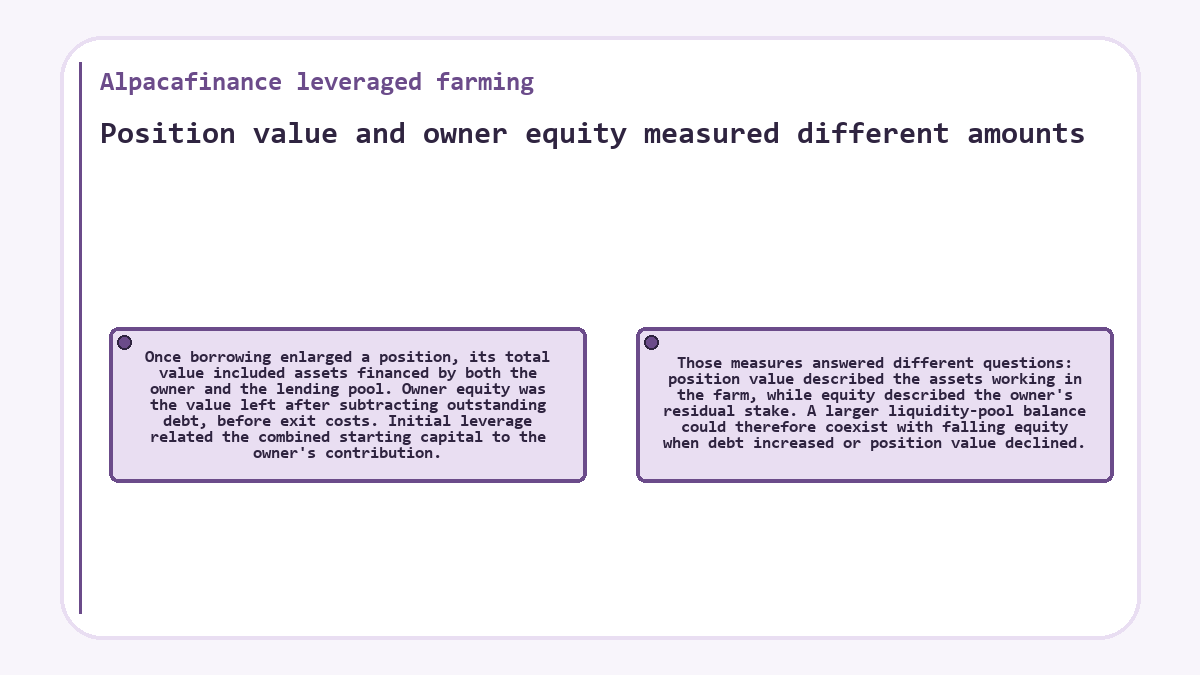
Position value and owner equity measured different amounts
Once borrowing enlarged a position, its total value included assets financed by both the owner and the lending pool. Owner equity was the value left after subtracting outstanding debt, before exit costs. Initial leverage related the combined starting capital to the owner's contribution. Those measures answered different questions: position value described the assets working in the farm, while equity described the owner's residual stake. A larger liquidity-pool balance could therefore coexist with falling equity when debt increased or position value declined.
A borrowing plan could change before capital moved
An unsubmitted AF1.0 allocation could be revised without moving assets into a farming position. Consider a hypothetical pre-wind-down AF1.0 CAKE-BNB plan on BNB Chain. Assume the farm initially allowed borrowing and had sufficient liquidity. Starting equity: 12.6 BNB; proposed loan: 12.6 BNB. Excluding swaps, fees, interest, and rewards, the plan produced 25.2 BNB of starting capital. That represented 2x leverage and a 50% initial debt ratio.
If lending liquidity fell before execution and could no longer cover the loan, the original allocation became unavailable. Repeating the same borrowing request would not create the missing capital.
Reducing only the proposed loan to 6.3 BNB produced 18.9 BNB of starting capital. Initial leverage fell to 1.5x. The debt ratio was approximately 33.33%, calculated as
6.3 / (12.6 + 6.3) * 100
.
This revision addressed the liquidity shortfall only if the pool could fund the smaller loan. Minimum debt and farm risk limits still applied. A farm which had disabled additional borrowing could support neither proposed loan, regardless of size. Less borrowed capital also meant less capital earning farming income.
The revised plan ended with unchanged personal equity and less proposed debt; no assets had moved. After an actual historical transaction, recorded position value and outstanding debt determined the starting ratio. Swaps and execution costs meant an already opened position could not necessarily be unwound for the original contribution.
Farming income had to cover the borrowing bill
When borrowing costs exceeded farming income, the enlarged position could lose equity despite continuing to collect rewards. Trading fees and farming incentives contributed income, while loan interest accrued against borrowed assets. A leverage multiplier alone could not describe the owner's net return. Comparing those flows required the same time interval and valuation unit, including changes in reward-token prices. Increasing borrowed capital raised the amount exposed to farming returns and the amount carrying interest. Both income and financing costs could change while the position remained open.
A falling reward-token price could reduce farming income without reducing the number of borrowed tokens the position owed.
The borrowed asset changed the direction of exposure
When the borrowed asset appreciated relative to the farming pair, repayment could consume a greater share of the position's value. A liquidity-pool position held a changing mix of its constituent assets as their relative prices moved. Debt remained denominated in the asset borrowed, with interest increasing the amount owed. Measuring the position only in dollars could hide a deterioration measured in that repayment asset. This was one reason the choice of borrowing asset mattered alongside the selected farming pair.
Borrowing also supported different directional and hedging arrangements where the farm permitted them. A larger farming balance did not automatically mean the same multiplier on exposure to every constituent token. Debt offset part of the assets held, so the position's net exposure followed their combination.
Debt ratios connected market movements with liquidation
As outstanding debt grew relative to position value, the position approached its applicable liquidation threshold. The debt ratio compared those amounts in the same asset unit: debt divided by position value. Interest could increase the numerator, while adverse relative-price changes could reduce the denominator. Pool-specific risk settings determined the liquidation boundary. Liquidators could then close an eligible position, with repayment and applicable charges reducing what remained for its owner.
Adding collateral could improve the ratio where supported, but it committed more owner capital without removing the existing debt.
Swapping costs reduced the capital deployed or recovered
When an entry or exit required swaps large relative to the underlying pool, price impact changed the value exchanged. The nominal sum of contribution and loan therefore overstated deployable farming capital if it ignored those costs. Closing a position introduced the corresponding concern for recoverable assets. Debt repayment still had to come from the proceeds available after unwinding. With the owner's contribution unchanged, lower leverage reduced borrowing, while swap requirements also depended on the assets supplied and the strategy handling the position.
Thin liquidity made this relationship more consequential. The project separately announced closures of most AF1.0 farms because underlying liquidity was low. That notice excluded PancakeSwap BNB-USDT at that stage. The exclusion applied to the particular closure notice; it did not establish permanent availability through the later protocol-wide wind-down.
Lenders faced a different constraint on returning capital
Higher utilization meant a greater share of lending-pool capital was on loan, leaving a smaller share unborrowed for withdrawals. Farmers paid interest for that capital, creating the lender's income stream. The interest model responded to utilization, so rising demand could also increase the farmer's financing expense. A higher lender return and a less attractive farming return could therefore reflect the same borrowing conditions.
Lenders also faced bad-debt exposure if liquidation failed to recover enough capital during sharp market movements.
Compounding and hedging addressed separate parts of farming
Reinvesting farm rewards increased the assets working in a position, while hedging changed its directional exposure. Compounding did not cancel borrowing interest or freeze the debt ratio. Automated Vaults later managed paired farming exposures and rebalancing, extending the use of the underlying lending mechanism. Their strategy rules differed from an individually managed AF1.0 position. Borrowed principal remained a liability even when the strategy managed exposure automatically.
The wind-down shifted attention to historical settlement
The May 2025 plan called for ending AF1.0 farming and settling its outstanding loans. The team planned to disable new farm positions by the first week of June 2025. The May 26, 2025 wind-down announcement scheduled automatic closure of remaining AF1.0 positions for June 30, 2025. Loans were to be repaid before any remaining value returned to the position owner. That sequence did not promise recovery of the original contribution.
The announcement committed to front-end access through December 31, 2025. That commitment period has passed. Its schedule did not establish the settlement outcome of every individual position. For a past position, its owner needs the actual settlement record to establish the assets left after repayment. An old leverage multiplier describes the starting allocation, while that remaining balance determines the owner's recoverable value.
What to know about Alpacafinance leveraged farming
What did AF1.0's Minimize Trading exit option change?
The Minimize Trading strategy aimed to reduce swapping when closing a farming position. Fewer required swaps could reduce trading fees and price impact. The position still needed to repay its loan, so the option did not make the entire liquidity-pool balance available to the owner. Its purpose concerned how assets were unwound, without promising recovery of the original contribution.
Were all AF1.0 farming rewards automatically reinvested?
The original AF1.0 design distinguished reinvested pool rewards from separately claimable ALPACA incentives. Pool rewards could be converted into more liquidity-pool tokens and compounded into the farming position. Bonus ALPACA followed a separate claim process. The distinction affected whether a reward had already joined the capital earning further farming income.
Did a stablecoin farming pair eliminate impermanent loss?
A stablecoin pair could still suffer impermanent loss if one constituent departed from its peg. The pool's rebalancing could leave the position holding more of the depreciating asset. Leverage could amplify the effect on the farmer's equity. A pair's stablecoin label therefore did not remove the price relationship governing the pool or the obligation to repay borrowed assets.
How was the original AF1.0 liquidation bounty calculated?
The original Whitepaper_v3 model applied a 5% liquidation bounty to the position's value at liquidation. Its base was the entire liquidated position, rather than only the outstanding loan or the owner's remaining equity. That historical model did not establish a permanent fee for every later configuration. The bounty also described liquidation, which was distinct from voluntarily closing a position.
Was there a minimum size for an AF1.0 farming loan?
AF1.0 included a configured minimum debt size for leveraged positions. Reducing a proposed loan could therefore cross a minimum even when it reduced the debt ratio. The applicable amount belonged to the lending configuration and its asset unit. A smaller borrowing request still had to satisfy this constraint, available liquidity, and the farm's other risk settings.
Which assets belonged to AF1.0's October 2023 lending migration?
The October 2023 Batch#1 migration covered BTCB, ETH, and USDC lending assets. In its October 2023 Recap, published November 9, 2023, the project reported closing remaining leveraged farming positions borrowing those assets and moving the corresponding lending-pool assets to AF2.0 pools. This asset-specific migration preceded the May 2025 plan to wind down all products.
Could an AF1.0 farming loan remain open without a fixed maturity date?
The original AF1.0 lending model allowed farming loans without a fixed repayment term. Outstanding interest and liquidation rules continued to apply while a position remained open. This arrangement helped explain why lenders could face withdrawal delays under high utilization. It did not prevent later farm closures, including the separate closure schedule announced during the 2025 wind-down.
Last updated -