 Alpacafinance
 vaults rebalanced farming positions to manage market exposure
Alpacafinance used Automated Vaults to adjust paired long and short farming positions as prices changed, targeting a defined market exposure. Its market-neutral strategies aimed to offset volatile-asset exposure, while Savings Vaults deliberately retained exposure to their named asset. Rebalancing managed those targets, and compounding reinvested farming rewards. Borrowing costs continued to affect net returns. The May 2025 wind-down announcement called for an immediate stop to all Automated Vault strategies and settlement of their assets.
Neutral strategies and Savings Vaults pursued different targets
The exposure target determined whether a vault sought to offset volatile-asset price movements or retain the named asset's direction.
Offsetting the volatile asset
Market-neutral vaults combined farming positions with opposing exposures to reduce the portfolio's sensitivity to the volatile asset. The January 2022 design called this a pseudo-delta-neutral strategy. Its objective was approximately zero net directional exposure while earning farming income. Holding a volatile asset outright had a different objective: its market value followed the asset's price. A hedge reduced dependence on that direction, although farming income and financing costs still determined whether the position earned a profit.
Retaining the Savings Vault asset
Savings Vaults used related long and short farming mechanics but targeted 1x long exposure to their named asset. The May 2022 range included a 3x BNB Savings vault using BNB-BUSD farming on PancakeSwap. Its 3x leverage and 1x long target described different dimensions of the strategy. Leverage enlarged its farming positions, while the combined hedge left net exposure to BNB. These Savings Vaults accepted a single asset and created the paired positions automatically.
How did automatic rebalancing respond to price changes?
Automatic rebalancing adjusted paired farming positions when their debt ratios reached the strategy's configured triggers. Price changes altered each leg's equity, disturbing the hedge formed at opening.
Each leg combined a farming position with borrowing. Debt ratio expressed debt relative to position value, with both measured in compatible units. Movement in the borrowed asset relative to the farming assets could change that ratio. The aggregate hedge and the debt ratio of an individual leg described different things. Opposing exposures could offset across the strategy even while the individual positions became uneven.
The adjustment sought to restore the intended balance between those exposures. Neutral strategies aimed back toward a hedge, whereas Savings strategies preserved their asset exposure. Rebalancing could itself incur trading costs. The Q4 2021 backtest, published on January 24, 2022, applied a 0.25% trading fee to amounts swapped during rebalancing. This was a simulation assumption, with the charge based on traded value.
Compounding addressed earned rewards by reinvesting them into the strategy. The original 2022 Automated Vault design specified compounding ALPACA rewards from its farming positions. Rebalancing addressed the relative exposures, so reward reinvestment and hedge maintenance described different operations.
The May 2022 interface update added rebalance occurrences and asset prices to the investment graph. It also displayed returns as percentages and showed debt-ratio rebalance thresholds. A rebalance event identified an adjustment; the return series addressed the separate question of how the invested balance performed over the selected period.
Why could a hedged vault still lose value?
A hedged vault still faced financing and execution costs, which could outweigh income from farming and liquidity provision. Borrowing interest accumulated against the positions, while rebalancing swaps incurred trading costs. The original simulation explicitly included both expenses. Stablecoin pairs also faced impermanent loss if an asset moved off its peg. Trading-fee yields fell after the May 2023 launch of an 8x BUSD-USDT market-neutral vault on PancakeSwap. Its withdrawal fee was 0% at that time, a setting specific to that vault.
The early liquidation design differed from manual hedging
The original Automated Vault proposal specified different keeper permissions for its managed positions, creating a distinction from separately maintained leveraged farms.
Individual farming positions retained liquidation thresholds
In ordinary leveraged farming, each position faced its own debt-ratio limit. A manually assembled long-and-short hedge could therefore have offsetting market exposures while one leg approached liquidation. The original farming whitepaper described liquidation against pool-specific thresholds. Each standalone position remained subject to those rules, including when its owner paired it with another farming position. Managing the overall hedge therefore still required attention to each leg's individual debt limit.
The proposed worker would prevent keeper liquidation
The January 24, 2022 design proposed a specialized worker which would prevent keepers from liquidating the vault's managed positions. Its rationale depended on the paired strategy's aggregate debt and equity. This was a product-specific design claim, with automatic rebalancing supporting the combined position. The May 2022 interface update subsequently added no-liquidation wording to Automated Vault descriptions. Neutrality described the hedge; the worker's permissions determined whether keepers could liquidate those managed positions.
Interpreting a vault return against its exposure target
If a historical BNB Savings balance gained BNB while BNB's dollar price fell, its dollar value could still decline. Its 1x long target made holding BNB over the same period the relevant comparison. A market-neutral vault pursued a different objective: reducing sensitivity to the volatile asset's direction.
- For BNB Savings, distinguish a return measured in BNB from a change in its dollar valuation.
- For a neutral strategy, distinguish reduced directional exposure from positive farming income after borrowing costs.
- Read a historical annualized rate with its actual measurement period; keep simulated performance separate from live returns.
- Treat rebalance occurrences and the return percentage as different observations, as the May 2022 interface did.
- Apply the May 2023 BUSD-USDT withdrawal-fee exception only to that vault and period.
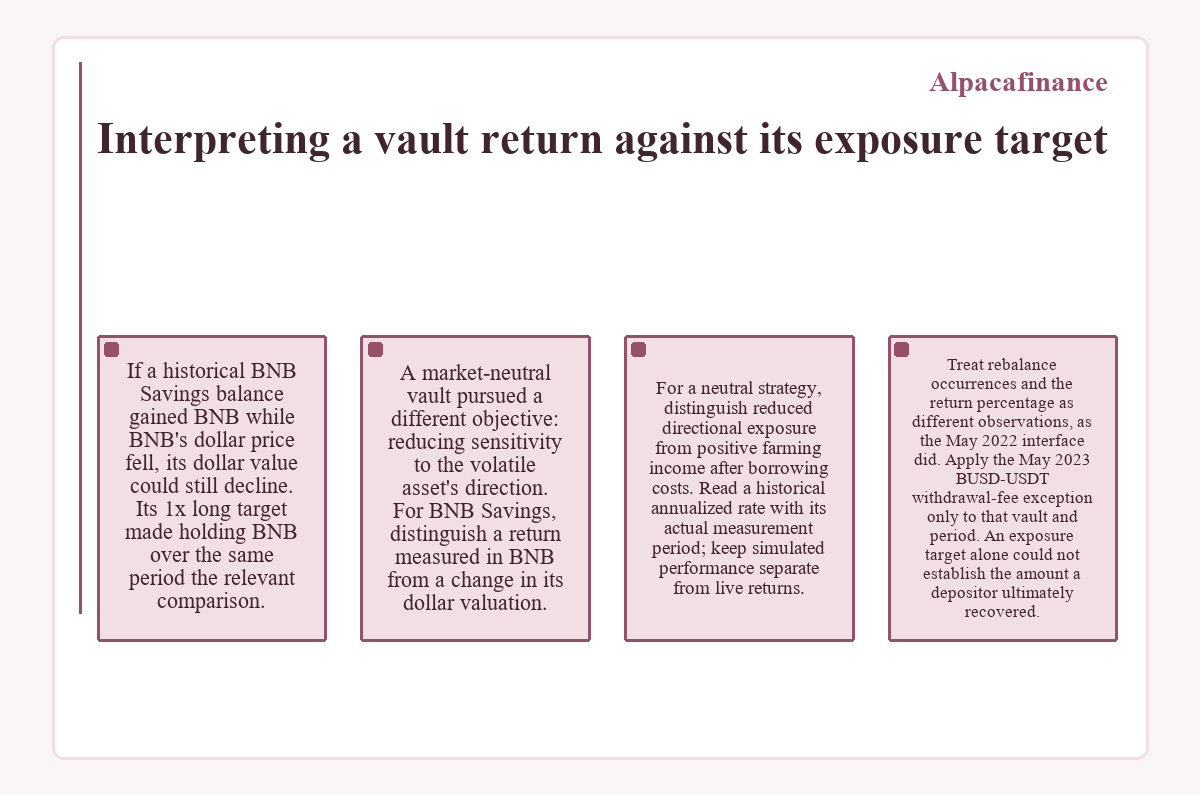
An exposure target alone could not establish the amount a depositor ultimately recovered.
The wind-down plan called for settlement in the base token
The May 26, 2025 wind-down announcement called for stopping all Automated Vault strategies immediately. It specified loan repayment and conversion of vault assets into their base token, including BNB for BNB Savings. These were announced settlement instructions, not confirmation of every individual outcome. The front-end commitment extended through December 31, 2025; it established no access commitment beyond that date. Any assets remaining after repayment would become base-token holdings, ending their participation in the vault's active farming strategy.
What to know about Alpacafinance
Was a vault without a lock-up also free to exit?
The absence of a lock-up did not establish a zero withdrawal fee. The January 2022 Automated Vault design described withdrawals without a lock-up. Separately, the May 2023 update specified a 0% withdrawal fee for the 8x BUSD-USDT market-neutral vault on PancakeSwap. That exception concerned its exit charge and did not remove borrowing or trading costs.
What did the 70% debt-ratio trigger mean in the early vault simulation?
The initial simulation rebalanced when one position's debt ratio exceeded 70%. The setup published on January 24, 2022 targeted 3x leverage and also tested other trigger thresholds. Those were backtest assumptions, not immutable settings for every later Automated Vault. The percentage described the ratio of debt to position value for an individual leg.
Did every Alpacafinance Automated Vault require xALPACA?
The May 2022 expansion plan reserved proposed Automated Vaults above 4x leverage for xALPACA holders when liquidity allowed their launch. That eligibility condition applied to the high-leverage expansion and did not establish a requirement for every vault. It described a historical allocation plan, not access to deposits following the 2025 wind-down announcement.
When did the project announce an Automated Vault sunset on Fantom?
The May 2022 Recap, published on June 9, 2022, announced the decision to sunset Automated Vaults on Fantom. That network-specific decision preceded the May 2025 wind-down covering all products. The earlier announcement also discussed possible expansion, which did not establish deployment or continuing availability on another network.
Had Automated Vaults launched by March 2022?
The March 2022 Recap, published on April 6, 2022, reported the launch of Automated Vaults during March. The January 24, 2022 introduction had described development in progress and targeted late February 2022.
Last updated -